The United Arab Emirates is continuously investing in advanced infrastructure, smart buildings, industrial facilities, and transportation networks. With increasing construction complexity and demanding environmental conditions, engineering professionals must prioritise energy efficiency, operational reliability, and occupant safety. Computational Fluid Dynamics (CFD) has become an important engineering technology for analysing airflow, temperature distribution, ventilation systems, and fire-related scenarios.
Through advanced numerical simulations, engineers can evaluate building and equipment performance under different operating conditions. These assessments help identify potential design challenges, improve mechanical system efficiency, and support safer infrastructure development. Professional CFD services are particularly valuable for projects requiring detailed engineering investigations and performance optimisation.
Understanding the Importance of Data Centre UAE Solutions
The growing digital economy has increased the demand for modern data centre infrastructure across the Middle East. The Data Centre UAE sector requires sophisticated cooling arrangements to maintain suitable operating temperatures for servers, networking equipment, and electrical installations.
Data centres generate considerable heat because their equipment operates continuously. Without proper cooling and airflow management, excessive temperatures can affect equipment performance and operational reliability.
Data Centre CFD simulations provide detailed information about airflow distribution, temperature variations, pressure differences, and cooling effectiveness. Engineers can examine hot and cold aisle configurations, evaluate cooling unit performance, and identify areas where airflow improvements are necessary.
These simulations help project teams optimise cooling strategies and develop infrastructure capable of supporting demanding operational requirements.
Advanced Engineering Applications of Ansys Fluent CFD
Accurate simulation technology is essential for understanding complicated fluid flow and thermal behaviour. Ansys Fluent CFD provides advanced capabilities for investigating airflow patterns, heat transfer, turbulence, and pressure distribution across different engineering environments.
Engineers use this technology to simulate real-world conditions and evaluate alternative design configurations. The results can help identify inefficient systems, improve ventilation performance, and support informed engineering decisions.
Applications include industrial cooling, HVAC design, fire safety engineering, equipment ventilation, and environmental assessments. By identifying potential problems during the design stage, simulation studies can reduce costly modifications during construction and commissioning.
Improving Mechanical Infrastructure with Chiller Yard CFD
Large commercial buildings, hospitals, industrial facilities, and data centres depend on reliable chiller installations for temperature control.
However, poorly planned equipment layouts can restrict airflow and create hot-air recirculation. This can reduce cooling efficiency and increase the operating demands of mechanical systems.
Chiller yard CFD examines airflow behaviour around chillers, surrounding structures, and mechanical equipment. Engineers can evaluate the influence of prevailing wind conditions, equipment spacing, ventilation openings, and discharge locations.
The simulation identifies potential airflow obstructions and recirculation zones. Based on these findings, engineering teams can recommend better equipment positioning and ventilation arrangements to support reliable cooling performance.
Cooling Tower Analysis for Better Thermal Performance
Cooling towers are essential components of industrial cooling systems and central HVAC installations. Their performance depends on effective heat rejection, airflow distribution, and suitable equipment positioning.
Cooling Tower Analysis helps engineers investigate airflow patterns around cooling tower installations and assess the potential for exhaust air recirculation.
CFD simulations can examine how neighbouring structures, wind direction, and equipment arrangements influence cooling tower performance. This information allows engineers to identify possible operational problems and evaluate alternative installation layouts.
A comprehensive assessment can support improved heat rejection, reduced recirculation risks, and more efficient mechanical infrastructure.
Enhancing Indoor Air Quality Through Thermal Comfort CFD Analysis
Indoor environmental conditions have a direct impact on occupant comfort and building functionality. Commercial offices, healthcare facilities, educational institutions, and public buildings require effective ventilation to maintain appropriate indoor conditions.
Thermal Comfort CFD Analysis evaluates temperature distribution, air velocity, and airflow behaviour within occupied spaces.
Engineers can identify areas experiencing uneven cooling, stagnant airflow, or excessive air movement. They can also investigate the performance of air-conditioning diffusers and alternative HVAC arrangements.
These findings help improve indoor environmental quality while supporting efficient building operations and occupant comfort.
Advanced Fire Safety Assessment Through Tunnel Fire Modelling
Transportation tunnels require specialised fire engineering assessments because enclosed environments present significant challenges during emergencies.
Tunnel Fire Modelling uses numerical simulations to investigate fire development, smoke movement, temperature distribution, and ventilation effectiveness.
Engineers can evaluate different fire scenarios and examine how smoke travels through tunnel sections under various ventilation conditions.
The results help identify potential safety concerns and support the development of suitable smoke control and emergency ventilation strategies. Such assessments contribute to better-informed tunnel fire safety designs.
Crowd Modelling and Egress Modelling for Occupant Safety
Buildings with high occupancy levels require carefully planned pedestrian circulation and emergency evacuation arrangements.
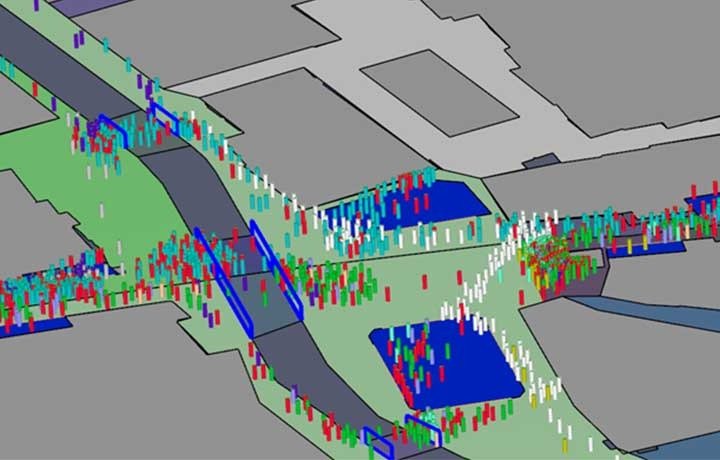
Crowd Modelling examines pedestrian movement, crowd density, walking behaviour, and congestion patterns within public facilities.
It helps engineers understand how occupants move through entrances, corridors, staircases, and shared spaces during different operating conditions.
Meanwhile, Egress Modelling evaluates emergency evacuation performance by examining exit capacities, evacuation routes, occupant movement, and estimated evacuation times.
Together, these assessments help identify potential bottlenecks and support more effective evacuation planning for airports, stadiums, shopping centres, and commercial developments.
Smoke Modelling for Comprehensive Fire Engineering
Smoke movement is one of the most important factors influencing occupant safety during building fires. Smoke accumulation can reduce visibility, increase exposure to hazardous gases, and complicate evacuation procedures.
Smoke Modelling evaluates smoke propagation, temperature development, ventilation performance, and extraction system effectiveness through computational simulations.
Engineers can assess different fire scenarios and examine the performance of mechanical smoke extraction and pressurisation systems. The findings support effective smoke management strategies and informed fire safety decisions.
Conclusion
CFD technology has become an essential part of modern engineering design and infrastructure development. From advanced cooling assessments to fire safety simulations, these services provide valuable information for improving building performance and operational reliability.
With specialised engineering knowledge, lavaconsultants delivers professional simulation assessments that support complex infrastructure requirements. Its approach focuses on accurate analysis, practical recommendations, and effective engineering solutions.
By integrating Ansys Fluent CFD, cooling assessments, and advanced fire engineering simulations, lavaconsultants contributes to safer, more efficient, and sustainable infrastructure development throughout the UAE.
CONGRATULATION! YOU’VE FINISHED THIS BLOG.